How Georgia Red Clay Affects Your Concrete Driveway
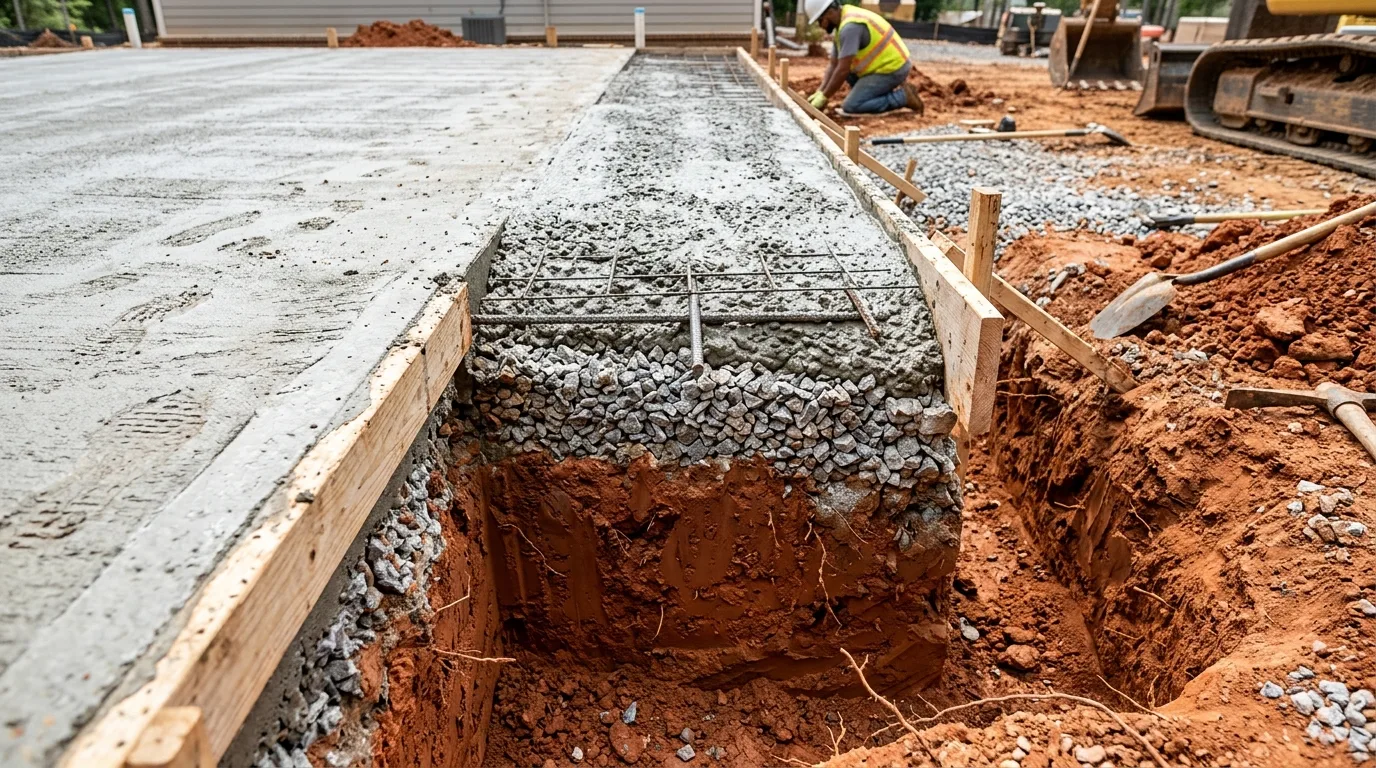
Georgia red clay is the defining soil condition for concrete work throughout Cobb County — and it’s the primary reason why two identical-looking driveways installed on the same street can behave completely differently over time. By fall, many Marietta homeowners discover that the driveway they had poured three years ago is already showing cracks and slight settlement, while their neighbor’s decade-old driveway looks solid. The difference almost always traces back to sub-base preparation and whether the contractor understood what Georgia red clay actually does to concrete over time. In this post, we explain the mechanics of clay soil’s effect on concrete, what proper installation looks like in Marietta, and what to ask any contractor before hiring them for concrete work in Cobb County.
Concrete Driveways Built for Georgia Red Clay
Every Marietta Concrete Works project includes proper sub-base preparation for Cobb County's clay soil. Free estimates available.
Why Georgia Red Clay Is Different From Other Soils
Georgia red clay — the iron-rich Piedmont region ultisol that gives Georgia its distinctive soil color — is an expansive clay with a clay content of 40–60%. The defining characteristic of expansive clay is that it changes volume with moisture: it swells when it absorbs water and contracts when it dries. In Marietta, this cycle repeats continuously as the soil responds to seasonal rainfall, summer evaporation, and individual rain events throughout the year.
The plasticity index of Cobb County’s red clay is moderate to high — meaning it has significant capacity for volume change with each moisture cycle. The bearing capacity of this soil (1,500–3,000 psf for typical clay profiles) is too low to support vehicle loads without a stabilizing base layer. These two characteristics together — volume change and low bearing capacity — explain why concrete poured directly on Marietta’s clay without a proper sub-base fails predictably and relatively quickly.
Types of Damage Georgia Red Clay Causes to Concrete Driveways
Surface cracking from differential settlement: When different sections of the clay sub-grade under a driveway expand or contract at different rates — due to variations in moisture, tree root activity, or drainage patterns — sections of the slab settle at different rates. This differential movement creates bending stress in the slab that exceeds the concrete’s tensile strength, causing cracks. In East Cobb neighborhoods built on rolling terrain, this is the most common failure pattern in driveways installed without adequate sub-base preparation.
Heaving from clay expansion: When clay beneath a driveway absorbs large amounts of water — during Marietta’s wet spring or after extended rainfall — it can expand enough to push the slab upward from below, particularly at slab edges where clay is most directly exposed to surface water. The resulting heave creates an uneven surface and joints that no longer align.
Settlement from clay contraction: The opposite of heaving — when dry-season or drought conditions cause Marietta’s clay to shrink below the slab, the clay pulls away from the underside of the concrete, creating voids. Over time, vehicle loads cause the slab to flex into those voids, creating cracks and permanent settlement. Tree roots along driveway edges are a significant accelerant of this process in Marietta’s older neighborhoods, because large trees actively draw moisture from the clay, intensifying dry-season shrinkage directly beneath the driveway.
Practical Uses: What Proper Sub-Base Preparation Looks Like
-
Excavation depth: For Marietta’s clay soil, proper excavation removes 8–10 inches of material — enough depth to accommodate a 4–6 inch compacted gravel base plus the 4-inch concrete slab. Contractors who excavate only 4–6 inches and pour directly on minimal gravel are shortcutting the most critical phase of the project.
-
Gravel base material and compaction: Crushed stone (crusher run or #57 stone) is compacted in lifts using a plate compactor. Each lift is compacted before the next is added. This creates a mechanically stabilized base layer with drainage capacity that the clay beneath lacks — water that reaches the base layer can migrate laterally rather than saturating the clay directly under the slab.
-
Reinforcement for clay conditions: Wire mesh provides baseline crack control. Rebar (#3 or #4 at 18-inch centers) provides structural reinforcement that bridges minor differential movement. For Marietta driveways on clay soil, rebar is strongly preferred over mesh alone — it provides the tensile strength that concrete lacks, bridging movement that would crack an unreinforced slab.
-
Control joint placement: Control joints are saw-cut or tooled into the surface at 8–10 foot intervals. They create planned weak points that concentrate the inevitable cracking at joints rather than randomly across the slab surface. Without control joints, cracks in Marietta’s clay-influenced driveways appear wherever stress is highest — often in the worst visual location.
-
Edge conditions: The slab edge is where clay movement is most directly expressed. Proper edge forming thickens the slab at perimeter edges (a thickened edge or integral curb), providing additional mass to resist the upward pressure of clay expansion at the edge.
How Soil-Concrete Interaction Plays Out in Cobb County Neighborhoods
The practical outcome of the soil-concrete interaction framing: Marietta homeowners who use contractors familiar with Georgia red clay conditions end up with driveways that look as good at 15 years as they did at installation. Homeowners who choose the lowest-bid contractor without asking about sub-base depth end up back in the market for a replacement driveway in 8–12 years — having spent the same money twice.
West Cobb neighborhoods near Powder Springs Road, where clay content in the soil is particularly high, see the fastest driveway deterioration from inadequate sub-base prep. The Chestnut Creek community and similar wooded East Cobb neighborhoods have the additional complication of mature trees near driveways — oak and sweetgum root systems that actively influence soil moisture beneath slabs. Understanding local soil conditions by neighborhood — not just by zip code — is part of what Marietta Concrete Works brings to every project estimate.
Frequently Asked Questions About Clay Soil and Concrete in Marietta
Can I pour concrete directly on Georgia red clay?
No — pouring concrete directly on Georgia red clay without a compacted gravel sub-base is the leading cause of premature concrete failure in Marietta. The clay’s low bearing capacity and volume-change behavior create conditions that will crack and settle any slab without an intermediate stabilizing layer. Minimum recommended sub-base is 4 inches of compacted gravel; 6 inches is preferable for driveways on Marietta’s heavier clay profiles.
How do I know if my concrete driveway failed because of clay soil?
Signs of clay-soil-related concrete failure include: diagonal cracks running from the corners of the slab toward the center, sections that have settled at different elevations, heaving at the slab edges or at control joint locations, and cracks that reappear after previous repairs. A combination of any two of these signs in a Marietta driveway is strong evidence of sub-base failure related to clay movement. Read our concrete repair vs. replacement guide for guidance on when these conditions warrant repair versus full replacement.
Does tree proximity affect concrete driveways in Marietta?
Yes — significantly. Large trees within 10–15 feet of a driveway in Marietta actively dry out the clay beneath the slab during summer, accelerating dry-season contraction and void formation. Root intrusion can also physically lift and crack a slab over time. If you’re installing a new driveway near mature trees in an East Cobb or Historic Marietta property, the sub-base design should account for the root zone and moisture-extraction effect of nearby trees.
Concrete Built for Georgia Clay — Free Estimates
Marietta Concrete Works designs every project for Cobb County's red clay conditions. Call (888) 376-0955.
Related: